
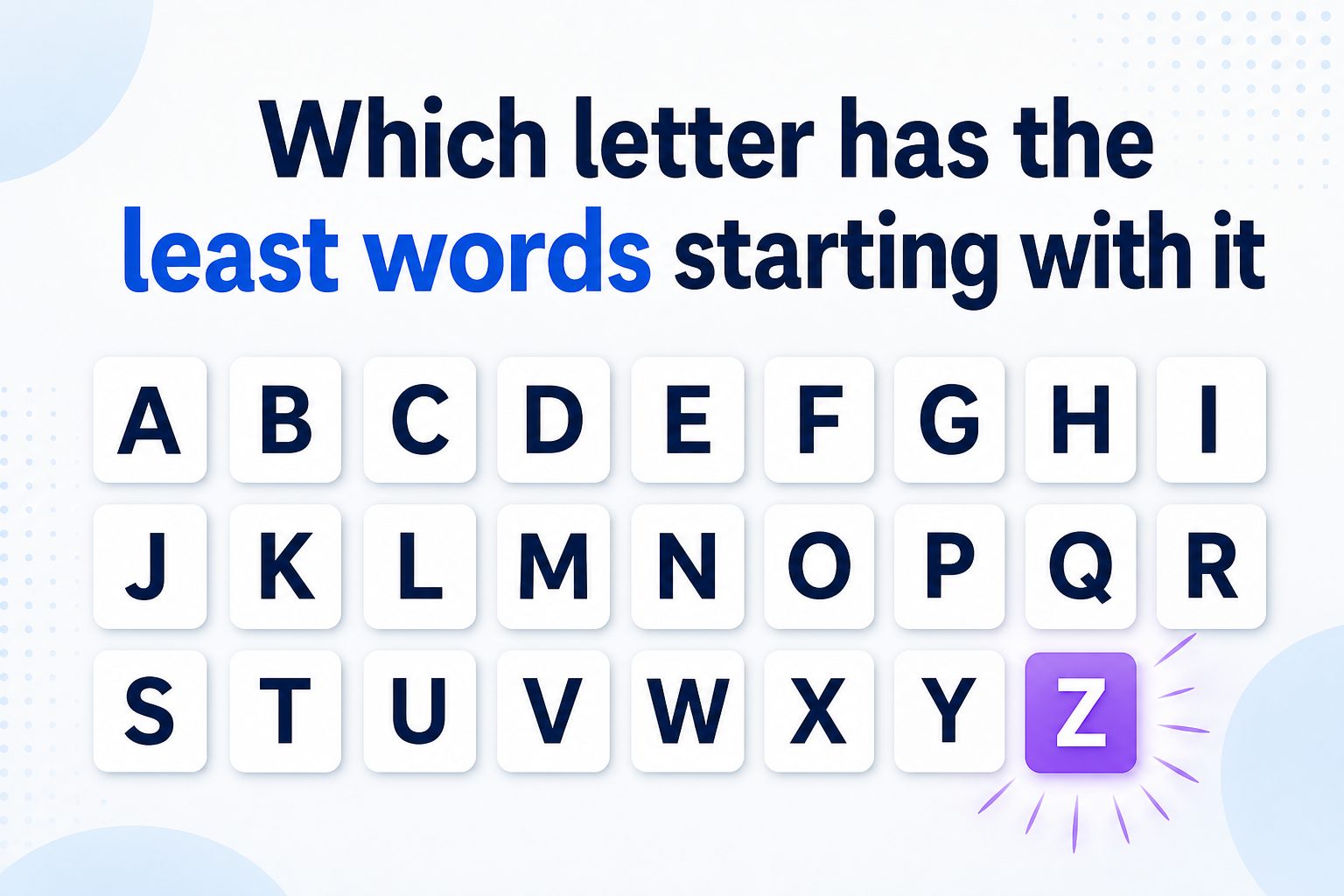
Which letter has the least words starting with it is a surprisingly interesting question because the answer depends on what kind of word list you are using. In everyday English, the letter X is usually considered the letter with the fewest common words that begin with it. You can think of words such as x-ray, xylophone, xenon, and xerox, but the list becomes short very quickly compared with letters like S, C, P, or A.
The reason is not that X is useless. It is simply rare at the beginning of English words. Many X words came from Greek, scientific naming, brand names, or borrowed terms, so they appear less often in normal speech and writing. Letters such as Q and Z are also uncommon, but they tend to have more recognizable everyday words than X.
This article explains the most accurate answer, why X has so few words, how dictionaries and word databases can change the ranking, and why this topic matters for spelling, word games, writing, teaching, and language learning.
In most practical English contexts, X is the letter with the least words starting with it. This is especially true when you focus on common, usable words rather than every technical, obsolete, scientific, or borrowed term.
A large dictionary may include more X words than most people expect, but many of them are specialized. Words such as xenotransplantation, xanthophyll, and xerography are valid, yet they are not words the average person uses every week.
Z and Q are the closest competitors. Z has words like zebra, zero, zone, zoom, zinc, and zipper. Q has queen, quick, quiet, quote, question, and quality. Both letters are uncommon, but they feel more familiar than X in daily communication.
The answer can change slightly if you count only official Scrabble words, only dictionary headwords, only modern words, or only words used in large collections of books and websites. However, X remains the usual answer for common English vocabulary.
So the simple answer is this: X generally has the fewest English words starting with it, while Z and Q are also among the least common starting letters.
Why Does X Have The Fewest Starting Words?
1. X Rarely Starts Native English Words
English inherited many common words from Germanic roots, French, Latin, and other languages, but very few everyday native English words naturally began with X. Because common vocabulary grows from repeated daily use, letters that were already common in older word sources became much more common at the beginning of words.
2. X Often Appears Inside Words Instead
The letter X is more comfortable in the middle or near the end of English words. Examples include box, extra, mix, text, next, and tax. This means X is not absent from English, but its position in words is unusual compared with letters that frequently start words.
3. Many X Words Come From Greek
A large share of English X words comes from Greek or Greek-based scientific vocabulary. Words such as xylophone, xenophobia, xerophyte, and xanthic reflect this pattern. These words are valid and useful in certain contexts, but they do not form a large everyday vocabulary group.
4. X Has A Difficult Starting Sound
At the start of English words, X often sounds like Z, as in xylophone and xenon. Because English already uses Z for that sound, X has less practical reason to begin many ordinary words. This sound overlap makes initial X feel less natural to English speakers.
5. X Is Common In Symbols And Labels
X appears often in mathematics, science, product names, ratings, abbreviations, and placeholders. That gives the letter strong cultural visibility, even though it does not start many standard words. Its symbolic power can make it feel more common than it actually is in vocabulary lists.
6. Dictionaries Include Many Rare X Terms
When people search for X words, they may find long lists, but many entries are technical, historical, regional, or rarely used. A dictionary can make X look richer than it feels in everyday life because dictionaries preserve specialized vocabulary that most speakers seldom need.
Which Letters Are Also Low In Word Counts?
1. Z is one of the least common starting letters, although it has more familiar everyday words than X.
2. Q is uncommon, but words such as question, quick, quite, quality, and quote make it easier to use.
3. J is less common than many central alphabet letters, but it has many names, verbs, and nouns.
4. K is not as rare as X, Z, or Q, but it appears less often than high-frequency letters like S and C.
5. Y has fewer starting words than many letters, though words like yes, young, year, and yellow are common.
Key Factors That Affect The Answer
- Dictionary Size: A small learner dictionary will show fewer X words than a large historical dictionary, so the source matters.
- Common Usage: If you count only words people actually use often, X becomes the clearest answer.
- Technical Vocabulary: Scientific and medical terms can add many X words, but they do not always reflect normal speech.
- Word Game Rules: Games may count unusual words, abbreviations, or variant spellings differently from standard dictionaries.
- Proper Nouns: Names, places, brands, and trademarks can change counts if they are included.
- Language Source: English borrows from many languages, so borrowed terms can affect how many words begin with rare letters.
How To Check Letter Word Counts Yourself
1. Choose One Word Source
Start by choosing a single dictionary, word list, or corpus. Mixing sources creates confusion because each one may include different spellings, technical terms, names, or outdated words. A consistent source gives you a cleaner and more reliable comparison.
2. Decide What Counts As A Word
Before counting, decide whether to include plurals, verb forms, abbreviations, proper nouns, hyphenated words, and foreign terms. This choice matters because rare letters often gain extra entries from specialized or borrowed words that may not feel like everyday English.
3. Group Words By First Letter
After preparing your list, group each word by its first letter. This makes the comparison simple and helps you see patterns quickly. You will usually notice that letters such as S, C, P, A, and M dominate, while X, Z, and Q sit near the bottom.
4. Separate Common Words From Rare Words
A raw count can be misleading because a letter may have many obscure entries but few practical words. Separating common words from rare words gives a more human answer, especially for readers who care about writing, spelling, teaching, or word games.
5. Compare X With Z And Q
The most useful comparison is usually between X, Z, and Q. These letters are the strongest candidates for the lowest starting-word count. Looking closely at these three letters will show whether your chosen source follows the usual pattern.
6. Review The Purpose Of Your Count
The best answer depends on why you are asking. A teacher, a crossword player, a linguist, and a content writer may all need slightly different definitions. For general English use, X remains the most practical answer.
The letter X is generally the letter with the least words starting with it in common English. Z and Q are also rare, but they usually have more familiar everyday words and a stronger presence in normal writing.
The exact answer can shift depending on the dictionary, word list, or counting method, especially when technical terms and proper nouns are included.
For most readers, the best takeaway is simple: X is the rarest starting letter in practical English vocabulary, and that is why it stands out in spelling lessons, word games, and language trivia.
FAQs About Which Letter Has The Least Words
Which Letter Has The Fewest Words Starting With It?
In common English, X usually has the fewest words starting with it. Some dictionaries may include many technical X words, but most of those are rare. For everyday vocabulary, X is the strongest answer.
Is Z Rarer Than X?
Z is rare, but it usually has more common starting words than X. Words like zero, zone, zoo, zip, zebra, and zoom are familiar to most speakers, while everyday X words are much harder to list.
Why Are There So Few X Words?
There are few X words because X rarely begins native English words and often appears inside words instead. Many initial X words come from Greek or scientific vocabulary, which makes them less common in daily speech.
Does Q Have Fewer Words Than X?
Q is uncommon, but it usually has more everyday words than X. Words such as question, quick, quiet, quote, queen, and quality are used often enough to make Q feel more practical than X.
Can The Answer Change By Dictionary?
Yes, the answer can change slightly depending on the dictionary or word list. Large dictionaries include rare, technical, and historical terms, while learner dictionaries focus on common vocabulary. Still, X is usually the lowest in practical English.
What Letter Starts The Most English Words?
Letters such as S, C, P, A, and M often appear near the top in English word lists. The exact leader depends on the dictionary and counting method, but S is commonly one of the strongest starting letters.